Annotation & Evidence #2
OBJECTIVE #2: Accurately interpret an audiogram
Activities/Resources:
-
Observe supervisor during audio testing on patients
-
Seek advice from professional career mentor
-
Create mapping key to develop an insight on the different types of hearing loss
-
Understand the symbols of an audiogram
Evidence:
-
Create example of an audiogram with mapping key
-
Develop a pamphlet describing the different types of hearing loss, along with recommendations regarding the patients type of hearing aid that may be needed
-
Create a detailed diagram that visually describes the difference between air conduction and bone conduction
The Interpretation of an Audiogram
For my second objective, the number one goal achieved, was to accurately interpret an audiogram. I shadowed my supervisor while she performed audios on different patients and I have gained valuable and useful skills during my observations. I developed a variety of insights on the different degrees and types of hearing losses, differences between air and bone conduction, and the symbols used on an audiogram.
Listed below is the evidence I used to accomplish my second objective. First, there are a few examples that represent the different types and degrees of a hearing loss. For my second piece of evidence, I described a detailed visual diagram of the ear which is broken down into two parts explaining the difference between air and bone conduction. As for the third diagram, I explained what an audiogram is and created a mapping key that is used when performing audio evaluations on a patient.
A. TYPES OF HEARING LOSSES:
Figure 1: Conductive Hearing Loss

This audiogram is an example of a conductive hearing loss which is caused by problems in the ear canal and/or the structures in the middle ear. This type of hearing loss occurs when an obstacle somewhere in the outer and/or middle ear stops airborne sound waves from reaching your inner ear. The most common causes of conductive hearing loss are wax build up, a perforated eardrum, fluid in the middle ear, or damaged ossicles. Approximately 10% of all hearing losses are conductive, which can range from mild to moderate in severity. Conductive hearing loss can often be medically treated, and in many cases, hearing can be restored. For individuals with permanent conductive hearing loss treatment such as hearing aids or bone-conduction hearing aids may be a feasible treatment option.
Figure 2: Sensorineural Hearing Loss

This chart is an example of a sensorineural hearing loss that is caused by problems in the inner ear or an auditory nerve dysfunction. It is known as the most common type of hearing loss and more than 90% of people who are hard of hearing have sensorineural hearing loss. The most common cause of this is damage to the tiny hair cells of the inner ear. This damage can occur with age or from repeated exposure to loud noise. Once they become damaged they are unable to convert sound vibrations into electrical signals required by the auditory nerve. This kind of hearing loss can occur suddenly or gradually and often cannot be reversed. A person who suffers from this type of hearing loss typically states that they can hear people speak, but not understand what they are saying. There is no medical treatment to correct this type.
Figure 3: Mixed Hearing Loss

A mixed hearing loss is caused by a combination of problems in the middle and inner ear or the auditory nerve. A person who suffers from a mixed hearing loss usually has strengths and weaknesses in their hearing. These individuals may have a noise induced hearing loss from noise exposure and/or perforation in the eardrum. This type of hearing loss results from a conductive and sensorineural hearing loss mixed together.
B. DEGREES OF A HEARING LOSS:

The chart above describes the different degrees of a hearing loss which is the amount of hearing that is heard from a patient and is measured in decibels. The frequency of a sound is measured in hertz which is the pitch of a sound. A normal range is between 0–15 dB HL (infant) and 0-25 dB HL (adult). Mild hearing loss usually ranges from 25-40 dB HL. With this degree of hearing loss the person appears to be able to hear soft sounds, can hear a normal conversation in a quiet room, has difficulty in a noisy environment, and cannot hear whispered conversation or speech from a distance. The range for a moderate hearing loss is about 40-55 dB HL. A patient with this degree of hearing loss has difficulty hearing a normal conversation in a quiet room, and they must use lip-reading or amplification to comprehend most words. A moderate-severe hearing loss ranges from 55-90 dB HL and a person who suffers from this hearing loss cannot hear a conversation without being spoken loud enough into the ear by the speaker. A patient who has a profound hearing loss ranges from 90+ dB HL, cannot understand speech even if their being yelled at, and they can only hear very loud sounds.
C. AIR AND BONE CONDUCTION:

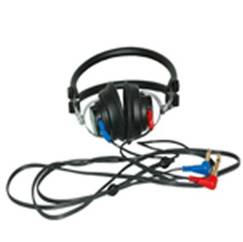
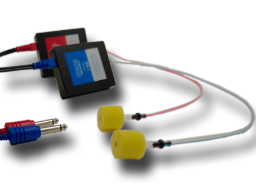
1. Air conduction: Is the course of sounds that are conducted to the inner ear by way of the outer and middle ear. A person with normal air conduction has normal hearing. Someone who has poorer hearing by air than bone eventually has conductive or mixed hearing loss. During audiogram evaluations the patient wears either headphones or inserts depending on the size of their ear canal for better results.
*Below is an example of regular (left) and insert (right) headphones worn by patients when being tested for hearing by air*
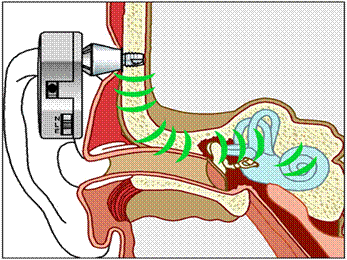
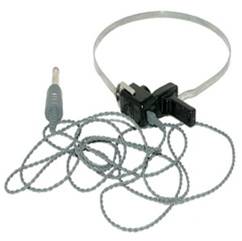
2. Bone Conduction: Is the course of sounds that are conducted to the inner ear by way of the bones of the skull. A person who has normal bone conduction has normal hearing or a conductive hearing loss. Someone that has that same hearing for air and bone conduction usually has normal hearing or sensorineural hearing loss. To test hearing by bone patients wear something similar to the headphones/inserts used for to test hearing by air. When testing the hearing by bone, patients wear headphones positioned on the temple and cheek. The electromechanical transducer, which converts electric signals into mechanical vibrations and sends sound to the inner ear through the cranial bones.
*Below is an example of headphones used and a diagram that concentrates only on bone conduction and how sound is processed to the cochlear.*
A. How sound travels from hearing by bone
B. Bone Ossicle Headphones for bone conduction
D. TWO MAIN DEVICES FOR AN AUDIO EVAULATION:
1. TYMPANOMETRY
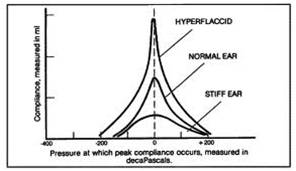
*Device used to test the condition of the middle air and mobility of the eardrum and the conduction bones by creating variations of air pressure in the ear canal. The normal air canal ranges from .07-2.0mL*
2. AUDIOMETER
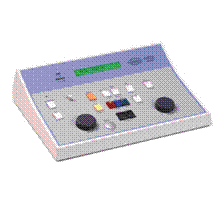
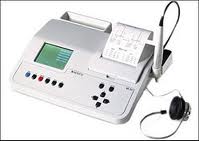
*Devices used for determining hearing thresholds with frequencies usually ranging from 250Hz - 8000Hz with decibel levels from 0-110 or sometimes 120dB.*
E. THE AUDIOGRAM AND ITS SYMBOLS:
Audiogram: An audiogram is a graph which audiologist use to record results using symbols to depict the threshold for each ear as a function of frequency and intensity. They perform these evaluations by using pure-tone audiometers. During an audio the audiologist breaks up the test into two parts known as, Speech Reception Threshold (SRT) and Speech Discrimination (SD). SRT is the average of 500Hz & 1000Hz & 2000Hz. SD is a measure of how well the patient understands speech presented at level above his or her threshold. It is measured in "percent correct" and can be used to determine how well one might do with hearing aids.
*Below is a chart that represents the symbols used for recording the results on an audiogram.*
*Below is a diagram that shows the different levels of where and a variety of kinds of sounds that can be heard on an audiogram. The yellow area shaped liked a banana is commonly known as the “Banano-gram or The Speech Banana.”*

*Below is an example of a blank chart used for recording the results of the patients hearing test*

The Symbols: The symbols are used to record the results of the patients audio. Most audiologist use the color red to represent the right ear and blue for the left ear.

A/C & B/C Masking: Masking means that one puts in some "noise" in the opposite ear while testing an ear. The reason to do this is to prevent sound from the side being tested from going over to the good side.